
Collagen Supplements: are they worth trying?
Is collagen worth taking? One of the questions I’m asked most often as a nutritional therapist.
Collagen is everywhere, and it’s one of the most heavily marketed supplements out there. But does the marketing hold up to the science?
Let’s look at what the research actually shows and whether that teaspoon in the morning is enough to make a difference or is just ruining your coffee.
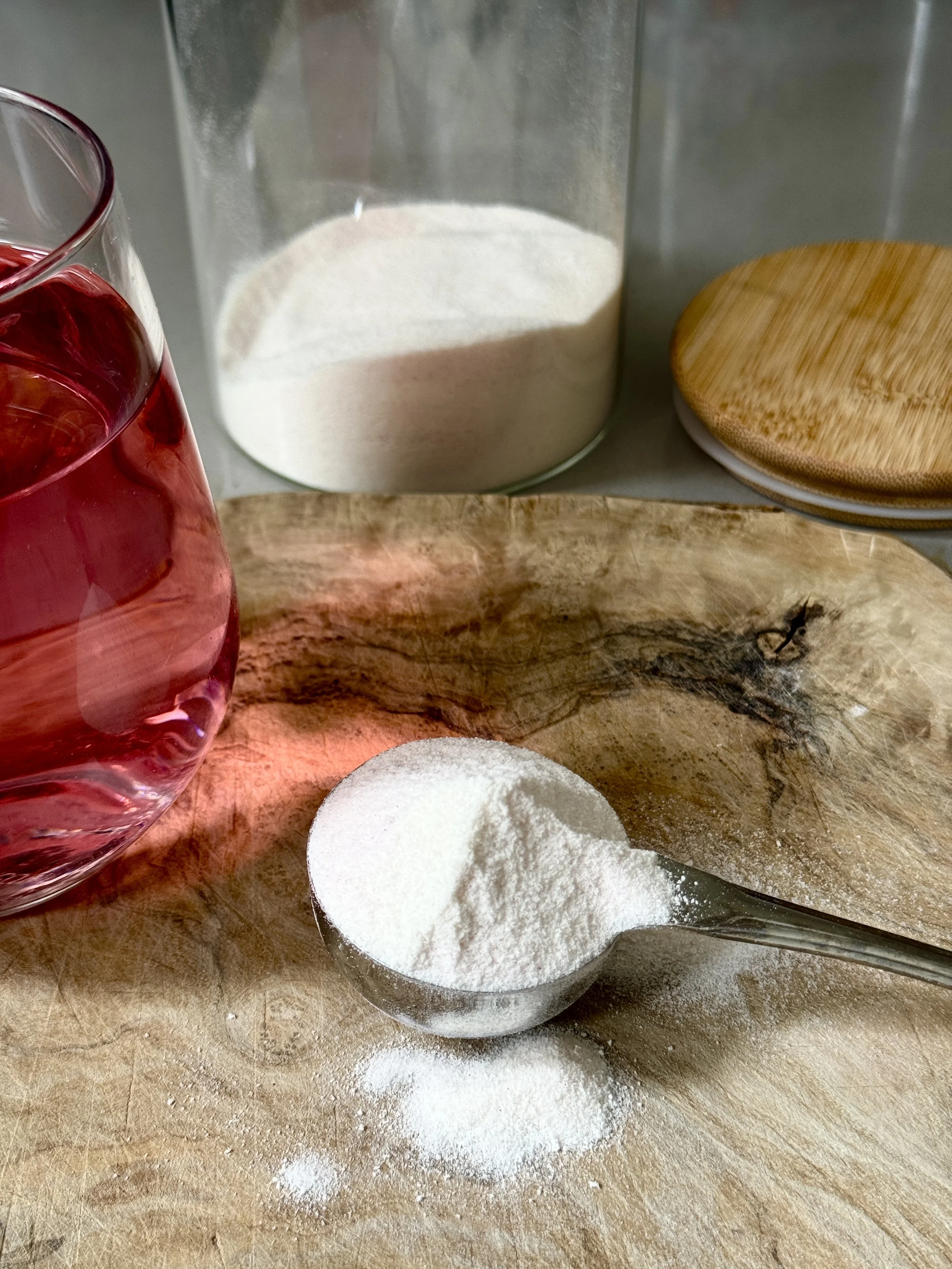
What is collagen?
Collagen is the most abundant protein in the body. It acts like scaffolding, helping to give skin its strength and elasticity, cushion and support joints, and keep the connective tissues surrounding muscles and organs strong and resilient.
The body makes collagen naturally, but its production and breakdown change with age. In women, the fall in oestrogen during perimenopause and menopause appears to accelerate changes in skin collagen, contributing to thinner, drier and less elastic skin. [1]
Collagen is made from a particular profile of amino acids. It is especially rich in glycine, proline and hydroxyproline, which are found in high amounts in connective tissue. This is why collagen supplements are commonly marketed for skin, hair, nails and joints.
Types of collagen
There are many types of collagen in the body, but types I, II and III are the ones most commonly discussed in relation to supplements.
Types I and III
Type I is the most abundant form of collagen and is found in skin, bones, tendons and ligaments. Type III is found alongside it in skin, blood vessels, muscles and other connective tissues, where it contributes to their structure and flexibility.
Marine collagen usually contains mainly type I, while bovine collagen commonly contains types I and III. Supplements intended for skin, hair, nails and general connective tissue support usually contain these forms as hydrolysed collagen peptides. This means the collagen has been broken down into smaller peptides to make it easier to digest and absorb.
Type II
Type II collagen is found mainly in cartilage and is therefore marketed for joint health, mobility and osteoarthritis-related symptoms.
Some joint supplements contain hydrolysed collagen peptides in gram amounts. Others contain undenatured type II collagen, which has been less extensively broken down and is usually taken in much smaller doses. It may act partly through an immune process called oral tolerance, rather than simply supplying amino acids. [2]
Does collagen actually target skin and joints?
Collagen powder is essentially a type of protein powder made from amino acids. However, unlike whey, soy or a well-formulated plant protein blend, it is not a complete protein because it does not provide all nine essential amino acids in adequate amounts.
These amino acids are described as essential because the body cannot make them and must obtain them through food. Together, they are needed to make the many proteins involved in tissue repair, muscle maintenance, enzymes, immunity and normal body function.
For this reason, collagen should not replace complete protein foods or be relied upon as the main way to meet daily protein requirements. It is better regarded as an additional source of collagen-related amino acids.
Once consumed, collagen is not simply sent directly to the skin or joints. It is digested into amino acids and small peptides, which are absorbed and used according to the body’s needs. If someone’s usual diet is low in protein, any improvement they notice could therefore be partly due to adding more amino acids rather than to a uniquely targeted collagen effect.
Some collagen-derived peptides can be detected in human blood after ingestion, while laboratory research suggests they may influence cells involved in connective-tissue production. [3] This offers a plausible explanation for more specific effects, but it does not prove that collagen performs better than a comparable amount of complete protein.
That comparison is largely missing from the research. Most clinical trials compare collagen with a placebo or no collagen, rather than with whey, soy or an equivalent increase in dietary protein.
What does the evidence say about collagen?
For skin, earlier research reviews reported modest improvements in hydration and elasticity. A 2023 review combined 26 clinical trials involving 1,721 people and found apparent benefits from hydrolysed collagen. Doses in the included studies generally ranged from around 2.5–10g per day, often taken for at least 8–12 weeks. [4]
However, a more critical 2025 review of 23 trials found that the overall positive results were largely driven by industry-funded studies. When the authors looked only at research without pharmaceutical or supplement-company funding, they found no clear improvement in hydration, elasticity or wrinkles. [5]
This does not prove that collagen has no effect, but it makes the evidence for skin ageing considerably less certain.
The evidence for joint pain and osteoarthritis may be more encouraging. Research reviews have reported improvements in pain and function, although the studies used different collagen preparations, doses and treatment periods, making it difficult to identify one effective dose for everyone. [6]
Studies of hydrolysed collagen for osteoarthritis and joint pain have generally used gram doses, with several trials using amounts around 5–10g daily. Some exercise and connective-tissue studies have used higher doses, but these should not be treated as interchangeable with osteoarthritis trials.
Undenatured type II collagen is different and is commonly studied at approximately 40mg per day. [7,8]
This is worth checking if you are simply adding a teaspoon of collagen to your morning coffee. Depending on the product and spoon size, this may provide around 3–5g. That overlaps with the lower end of some skin studies, but may not match the dose, formulation or duration used in joint research.
So, if you are expecting a result, check the actual grams per serving rather than relying on the spoon size alone. Dose, consistency and timeframe all matter.
Diet & lifestyle foundations
For skin health, the foundations still matter: getting enough protein, vitamin C-rich foods, zinc, copper, colourful plants, hydration, sleep, sun protection and not smoking. If you’re unsure how much protein you need, my guide to hitting your daily protein target gives practical examples using everyday foods.
For joints and connective tissue, appropriate movement, strength training, loading and recovery are also important. Collagen is unlikely to compensate for a low-protein or nutrient-poor diet, high UV exposure, poor sleep or a lack of appropriate movement. If you’d like to understand why protein becomes particularly important as we get older, you can read more in Why Protein Matters More in Midlife.
It can also be difficult to know exactly why someone notices an improvement after starting collagen. It may reflect a specific peptide effect, an increase in overall amino acid intake, changes elsewhere in their diet or lifestyle, or simply the natural fluctuation of symptoms such as joint discomfort and skin dryness.
So, is collagen worth taking?
The evidence is just not there, particularly for skin. Collagen may offer modest benefits in some contexts, but it is best considered as an addition to a balanced diet with adequate protein, like icing on the cake rather than a foundation.
The evidence for osteoarthritis-related pain and function may suggest modest improvements, although studies use different products and doses, and generally compare collagen with a placebo rather than with an equivalent amount of complete protein.
If you choose to trial collagen, use a dose and timeframe that reflect the research, but get your foundations in place first, and you may find that you see improvements in your skin and joints without buying an expensive supplement!
Looking for more personalised support?
Protein needs are just one part of the picture. If you'd like personalised nutrition support based on your diet, health concerns and goals, you can find out more about working with me here.
References
Thornton MJ. Estrogens and aging skin. Dermatoendocrinol. 2013;5(2):264–270. doi:10.4161/derm.23872.
Martínez-Puig D, Costa-Larrión E, Rubio-Rodríguez N, Gálvez-Martín P. Collagen supplementation for joint health: the link between composition and scientific knowledge. Nutrients. 2023;15(6):1332. doi:10.3390/nu15061332.
Iwai K, Hasegawa T, Taguchi Y, et al. Identification of food-derived collagen peptides in human blood after oral ingestion of gelatin hydrolysates. J Agric Food Chem. 2005;53(16):6531–6536. doi:10.1021/jf050206p.
Pu SY, Huang YL, Pu CM, Kang YN, Hoang KD, Chen C. Effects of oral collagen for skin anti-aging: a systematic review and meta-analysis. Nutrients. 2023;15(9):2080. doi:10.3390/nu15092080.
Myung SK, Park Y. Effects of collagen supplements on skin aging: a systematic review and meta-analysis of randomized controlled trials. Am J Med. 2025;138(9):1264–1277. doi:10.1016/j.amjmed.2025.04.034.
Liang CW, Cheng HY, Lee YH, Liao CD, Huang SW. Efficacy and safety of collagen derivatives for osteoarthritis: a trial sequential meta-analysis. Osteoarthritis Cartilage. 2024;32(5):574–584. doi:10.1016/j.joca.2023.12.010.
Kumar P, Bansal P, Kumar A, et al. Efficacy of undenatured collagen in knee osteoarthritis: review of literature. J Orthop. 2023;41:16–23.
Gupta A, Maffulli N. Undenatured type II collagen for knee osteoarthritis. Ann Med. 2025;57(1):2493306. doi:10.1080/07853890.2025.2493306.